


I’m preparing a talk on communication challenges for quantum tech startups for the Quantum Education Summit in Barcelona next month, and I’ve been thinking a bit about the difference between communication and education.
The question about communication vs. education comes up a bit actually. At Quantum Salon, we do deep tech communication, which sounds a bit like science communication, which overlaps with education. And so it’s easy to confuse what we do with what other companies—that focus on education and training within the quantum ecosystem—do.
So today, I wanted to spell out the difference, at least how I see it.
Communication vs. Education
Both communication and education involve a sender and a receiver of information: the communicator and the audience.
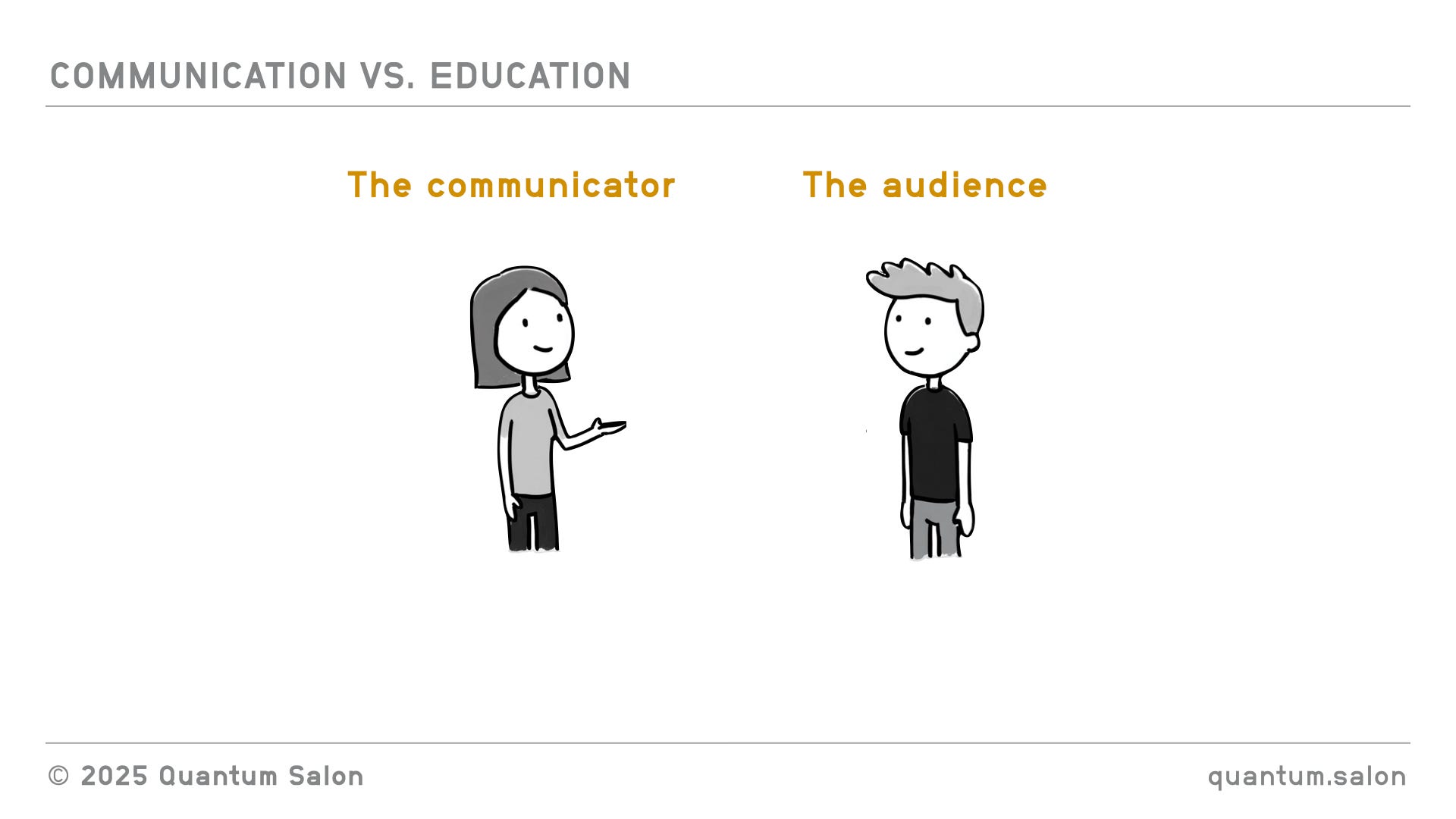
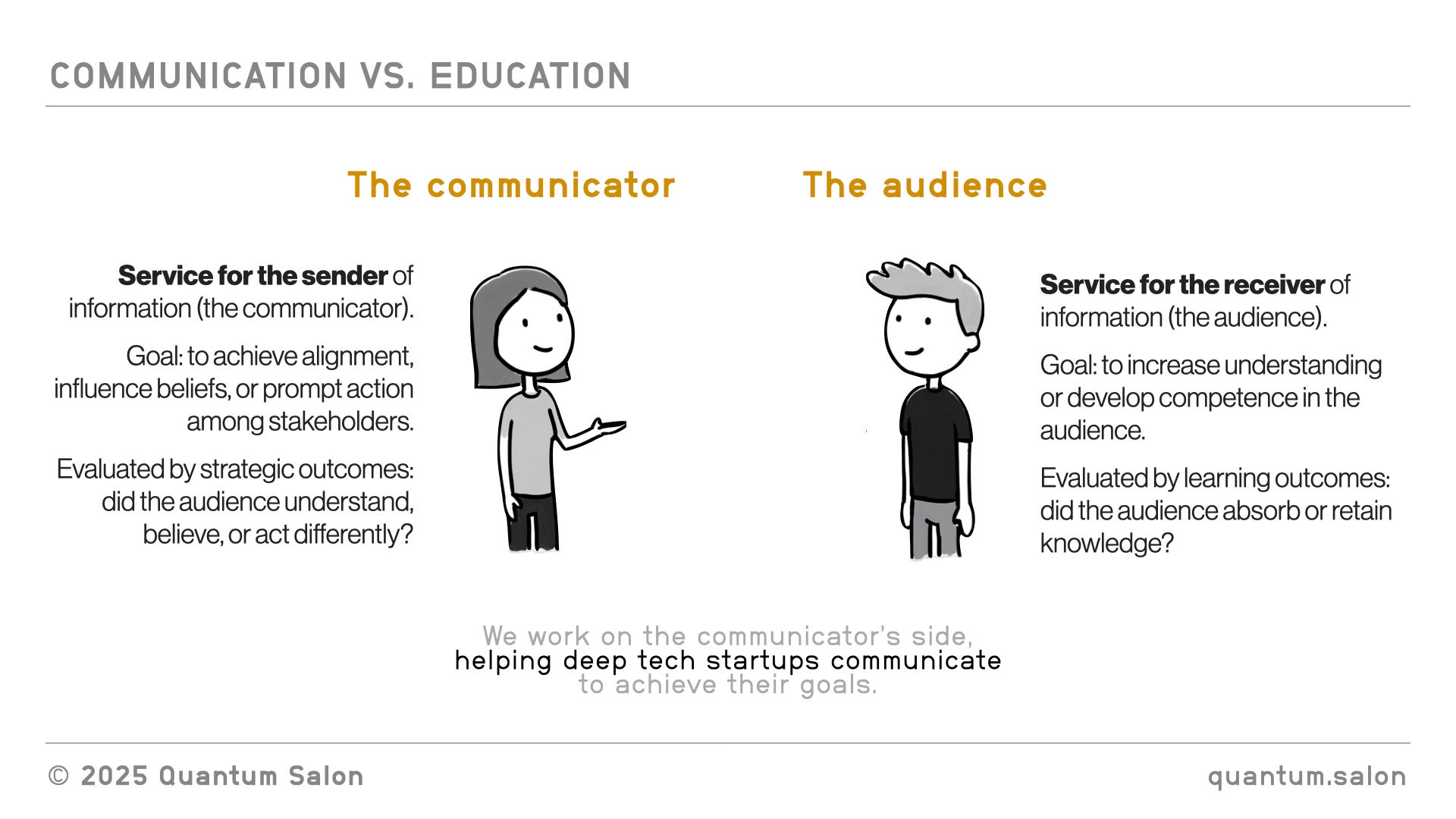
But education is for the audience. It’s about helping someone understand something new, build a skill, get better at it. While communication is for the communicator. It’s about helping a person (or a company) align people, change how they see things1, or get them to take action.
Sometimes both happen at the same time, which is why I think of them as two sides of the same coin. But when you’re trying to understand what a communication or education company does, you have to ask who they are serving: the communicator or the audience?
What does Quantum Salon do?
We work on the communicator’s side, helping deep tech startups get their message across so they can achieve their goals. Usually these goals are things like: get funding, hire new talent, keep investors happy, keep current employees happy, develop academic partnerships, get customers, etc.
Each kind of communication—marketing, public relations, management, technical, political, and so on—has its own area of expertise. Marketing speaks to customers, government relations speaks to policymakers, internal comms speaks to employees.
But for quantum tech startups, and deep tech startups more broadly, the challenge is the wide variety of stakeholders. Each has their own language, incentives, priorities, and biases. Our focus is on helping startups develop a communication plan so their efforts stay aligned rather than scattered.
Quantum Salon Insights is an independent reader-supported research project focused on making sense of the quantum tech ecosystem.
Here we explore the ideas, patterns, narratives, and structural misalignments that show up across quantum tech and adjacent deep-tech fields.
To receive new posts and support this work, consider becoming a free or paid subscriber.
This can go two ways: convincing people of things that aren’t true, or helping them see what is true but hasn’t been communicated well. We’re firmly in the second camp.
Great article! You outlined an important distinction very clearly. I like the point that education and communication sometimes overlap.
Would you say,
Education
=training
and
communication
=inference
?